AI Receptionist for Auto Repair Shops: You're Answering the Wrong Calls
Most auto repair shops buy phone cover to stop missing after hours calls. The costlier miss happens at 10am on a Tuesday, when the advisor takes the quick price question and sends the diagnostic caller to voicemail.
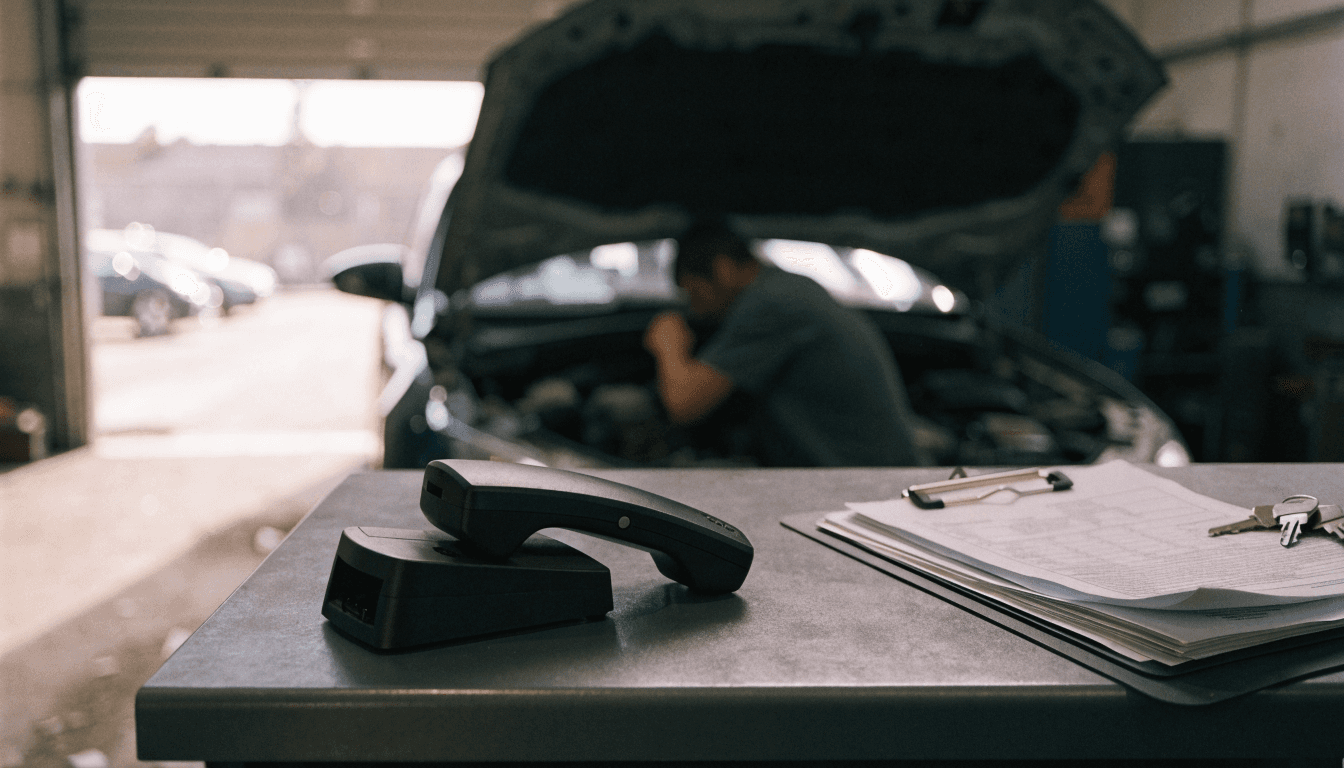
AI receptionist for auto repair shops: you're answering the wrong calls
Monday, 8:40am. Four cars in the bays, two more on the forecourt, and the service advisor is halfway under a bonnet with a torch in his teeth. The phone rings. He takes it, because the caller wants to know how much for an oil service and that's a ninety second conversation.
Twenty minutes later it rings again. This time he is writing an estimate with a customer standing in front of him, so it goes to voicemail. That caller had a brake warning light on since the school run and a car she didn't trust to drive. She rang the next shop on the map before she'd left the car park.
That's the actual shape of the problem, and it isn't the volume of missed calls. It's which ones get missed.
What an AI receptionist for auto repair shops does
An AI receptionist for auto repair shops answers every inbound call on the first ring, asks what the vehicle is doing, captures the make, model, mileage and symptoms in the caller's words, then books the slot or flags a tow. It runs through the morning bay rush and after you lock up, so the diagnostic call never reaches voicemail.
Here's what most people get wrong
Shops buy phone cover to stop missing calls after hours. That's a reasonable instinct. The after-hours miss is also the easy one to count, which is precisely why it gets all the attention and all the marketing.
The expensive miss happens at 10am on a Tuesday while you're open and fully staffed.
Here is the mechanism. When your advisor is buried, he doesn't ignore the phone at random. He answers the calls he can clear fast. A price question, or a parts supplier chasing an invoice. Short calls that let him get back under the car.
The call he can't take in forty seconds is the one where somebody is describing a noise. And the call where somebody describes a noise is the one attached to a diagnostic, a strip down, and a four figure ticket.
So your shop isn't missing a random slice of its calls. It's missing a selected slice, weighted toward the longest conversations, which are weighted toward the biggest jobs. Your answer rate can look respectable while the leak sits entirely in the calls you skipped.
That's the number almost no shop reports, mostly because it's harder to pull than a plain answer rate.
Run the arithmetic on your own shop
The 2023 Ratchet+Wrench Industry Survey asked shops what their average repair order was. The answers spread a very long way. Around 19% of shops reported an ARO of $1,000 or more. Roughly half reported $600 or above. About 13% came in under $200.
That spread is the whole point. A missed call isn't worth your average ticket, because the calls you miss aren't average calls. They skew to the top of your range.
Take a shop sitting in the middle of that survey. One genuinely missed diagnostic enquiry per working day is about 20 lost chances a month. Convert half and you've still left ten repair orders unwritten. At $600 each that's $6,000 a month of work that went to whoever picked up the phone.
Those figures are American, so if you're running a shop in Birmingham or Leeds, swap in your own ARO before you react to the number.
And don't take my framing on faith. Pull last month's call log, filter for calls under fifteen seconds and anything that hit voicemail, then ring twenty of them back and ask what they needed. You'll learn more in one afternoon than from any vendor's ROI calculator, mine included. We publish the ROI math and I would still rather you checked your own log first.
What to actually make it do
Most of the value is in the capture, not the greeting.
Get the symptom in the caller's words rather than a dropdown category. "Grinding when I brake, worse going downhill" tells your advisor something. "Brakes" doesn't, and it books the wrong length of slot.
Take the registration, make, model and rough mileage at the top of the call, while the caller is still talking freely. Reading it back to a customer who's already explained their problem twice is how you lose them.
Ask whether the car is drivable. That single question sorts a booking from a recovery, and it's the one your voicemail will never ask.
Book into something real. A live diary your team actually works from, not a form that lands in an inbox and waits for somebody to notice it.
Then get out of the way when a human is better. A caller arguing about last month's invoice should reach you, not a bot being patient at them.
The other thing worth checking is what happens when four people call at once, which in a repair shop is most of Monday. One person can hold one line. Software does not have that constraint, and we wrote about why concurrency matters more than it sounds.
What it will not fix
It won't price a job. Anyone selling you a phone agent that quotes brake work sight unseen is selling you a future complaint.
It won't diagnose, and it shouldn't try.
It'll mishear a registration plate when an impact wrench goes off next to the counter, so you want a confirmation step built into the flow.
And if your diary lives on a whiteboard above the parts shelf, there's nothing for it to book into. Fix that first, then look at the phone.
FAQ
What is an AI receptionist for an auto repair shop?
It is a voice agent that answers your shop's phone, takes vehicle and symptom details, books the appointment into your diary and passes anything unusual to a human.
Can it book appointments into my shop management software?
Yes, if your system has an API or a calendar you can share. Confirm this before you buy, because a phone agent that can't write to your diary just creates a second to-do list.
Will my customers know they are talking to an AI?
They should. We tell shops to have the agent say so in the first line. Callers mind far less than owners expect, so long as they get booked in and nobody wastes their time.
How does it handle a breakdown or a tow?
By asking whether the vehicle is drivable early in the call, then routing a no to whoever handles recovery for you, or texting the caller your tow partner's number.
How much does an AI receptionist for auto repair shops cost?
Pricing sits on our pricing page. The number that decides it is not the monthly fee, it is how many repair orders a month you are currently losing to voicemail.
Can it take several calls at the same time?
Yes. That's the main structural advantage over a single front desk person, and it matters most during your morning rush.
What if the caller asks something it cannot answer?
It should say it doesn't know and offer a callback or a transfer. An agent that guesses at a brake quote costs you more than the missed call did.
Do I have to change my phone number?
No. You forward your existing line, either all calls or only the ones nobody picks up within a set number of rings.
Where to start
Don't switch your main line over on day one.
Point your overflow at it. The calls that currently ring out, plus everything after close. Run it for two weeks on the 15 day free trial, then compare the booking log against the same fortnight last month.
If it hasn't written more repair orders than it cost, you'll know, and you won't have risked a single customer who was already getting through.
Source: 2023 Ratchet+Wrench Industry Survey Report, published 11 August 2023.