AI Receptionist for Property Management: Your Leasing Calls Are Losing to Your Maintenance Calls
Property management offices run two businesses through one phone number: tenant services and lettings. Tenant calls are long and keep trying. Leasing enquiries are short, perishable and ring the next agent on the list.
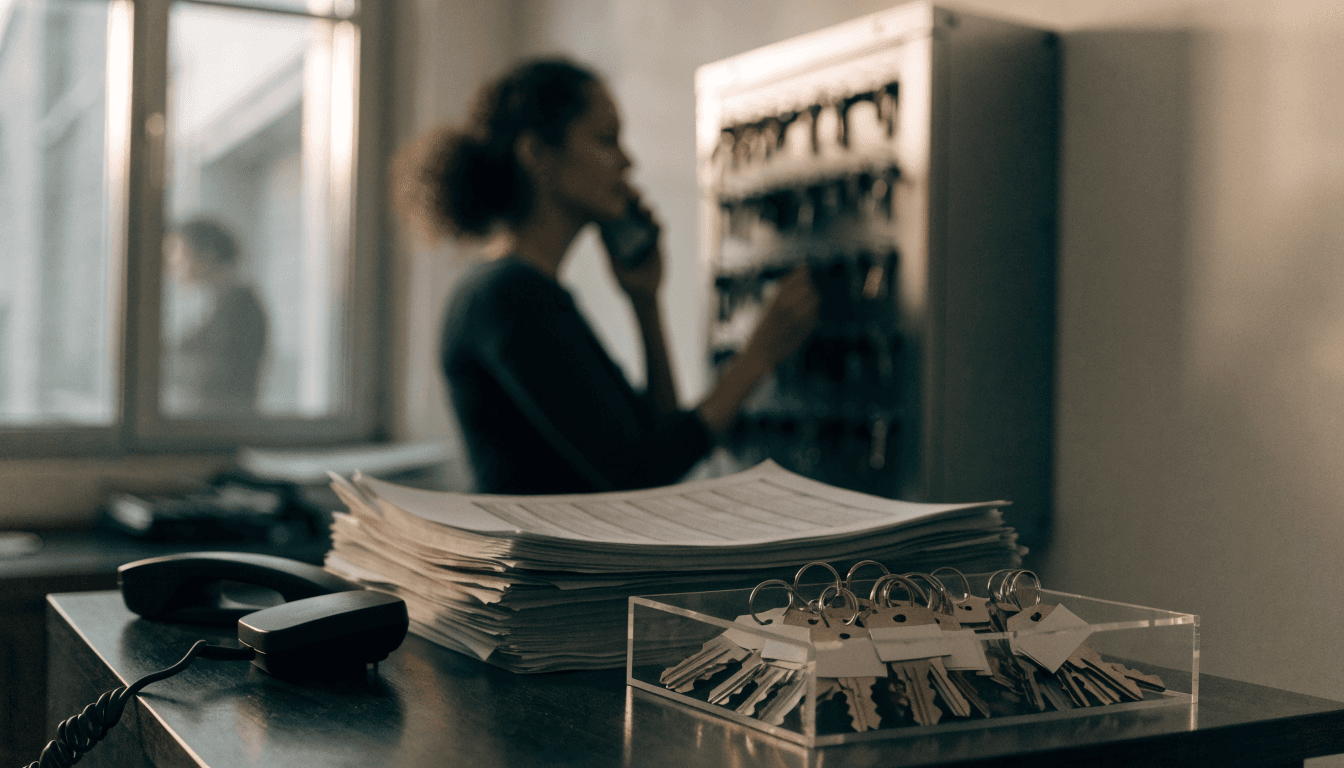
AI receptionist for property management: your leasing calls are losing to your maintenance calls
Tuesday, 2:10pm. The property manager has been on the phone nineteen minutes with a tenant whose radiator is cold, walking her through the boiler reset twice because the first attempt didn't take.
Three calls came in while that was happening. A contractor confirming a window measurement, a tenant asking when her deposit certificate lands, and a woman who had seen a two bedroom listing at lunchtime and wanted to know if she could view it on Saturday.
She got voicemail. She didn't leave a message. She rang the agent on the next listing, and by Saturday morning she had seen two flats, neither of them yours.
The short version
An AI receptionist for property management answers every inbound call on the first ring, separates tenants from prospective tenants, triages maintenance by urgency, and books viewings into the diary. Round the clock cover is the part that gets sold. The useful part is making sure the revenue call never queues behind the cost call.
One phone line, two different businesses
Most property management offices run two businesses through one phone number.
The first is tenant services. Repairs, deposits, rent queries, lease paperwork, the neighbour with the dog. That work protects revenue you already hold.
The second is lettings. People who saw a listing an hour ago and are deciding today which agent gets their Saturday.
The two have nothing in common except the handset. Tenant calls run long and they repeat. Leasing calls are short, high intent and perishable. Both land in the same queue, answered by the same person, in whatever order they arrive.
Your highest value calls are being rationed by whoever is mid conversation about a dripping tap.
Here's what most people get wrong
Property managers buy phone cover to catch the 11pm leak. Burst pipe, no heating in February, a smell of gas, somebody locked out at midnight. It feels like the obvious gap, because the consequences are loud and the call is easy to count.
The 11pm leak is also the call most likely to survive being missed. That tenant has nowhere else to go. They ring again at 11:04, then at 11:20, then at seven the next morning. You lose goodwill, and over enough winters a renewal, but you rarely lose the relationship in one night.
The 2pm viewing enquiry has nowhere to go but your competitor.
She has four other tabs open, no account with you and no reason to try twice. One voicemail greeting is enough to move her along, and she'll never appear in your reporting, because a call nobody answered and nobody logged shows up only as a vacancy that stayed open an extra eleven days.
So: your answer rate can look respectable while the calls you dropped were sorted, by accident, in reverse order of value.
What the renewal data says
Buildium surveyed 1,500 US renters in spring 2026 for its 2026 Renters' Report. 84% of them expect a response inside 24 hours, and 61% expect same day or faster. Renters satisfied with how their management company communicated were 58% more likely to say they planned to renew. Satisfaction with maintenance tracked almost identically at 57%.
Worth saying plainly: that is a software vendor surveying the market it sells into, not independent research. Treat the direction as useful and the decimal places as marketing.
The direction matches what I hear from managers anyway. Renewal decisions get made months earlier, in small moments where somebody either picked up or didn't.
Run the numbers on your own portfolio
The National Apartment Association published a worked example from property manager Lori Hammond that puts turnover somewhere between $1,000 and $5,000 a unit, using $1,800 as a working average. On that basis a 225 unit community turning over 40% a year carries around $162,000 in turnover cost, and cutting one move out a month saves north of $20,000.
That's a practitioner's estimate rather than a study, and your own cost per turn will differ. Use the shape of it, not the figure.
Then pull two numbers off your own phone system. How many calls rang out or hit voicemail between 9am and 6pm last month, and how many of those came from a number that had never called you before.
The first number is an answer rate problem. The second number is your lettings pipeline walking out of the building.
Most managers can get the first and not the second, which is a decent part of why this keeps happening.
What an AI receptionist for property management handles
It picks up on the first ring, including the four calls that arrive while the manager is mid boiler reset. It asks who's calling and why, then routes on the answer rather than on arrival order.
For a tenant it takes the address, the unit, the fault and the access window in the caller's own words, grades it against your rules for what counts as an emergency, and either raises the job or holds it for the morning. For a prospective tenant it confirms the property is still available, checks the obvious disqualifiers like move in date and pets, offers the viewing slots that are actually open, and books one.
It runs after you lock up, and at 2:10pm on a Tuesday when all three of your people are already on calls. Six callers at once costs the same as one. More on why that matters in concurrency and why one receptionist cannot take six calls at once.
Everything it captures writes back with a recording and transcript, so the 2pm enquiry exists in your reporting whether or not anybody human spoke to her.
Where it still falls over
A tenant standing in four inches of water wants a person, and the agent should hand over fast. We're honest about this elsewhere in what AI receptionists still get wrong.
Lease interpretation is another. Anything that amounts to a legal reading of a clause should go to a human with the file open, not a voice agent working from a knowledge base.
The agent is also only as current as your availability data. Point it at a stale listing feed and it will cheerfully book three viewings for a flat that went under offer on Friday. That's a data plumbing issue rather than a limit of the agent, and worth sorting first.
FAQ
What does an AI receptionist for property management do?
It answers inbound calls, identifies whether the caller is a tenant or a prospect, triages maintenance against your emergency rules, books viewings, and logs every call with a transcript into your property management system.
Can an AI receptionist handle emergency maintenance calls?
It triages them. You define what counts as an emergency, such as no heat, no water, a gas smell or a safety risk, and the agent escalates those to your on call number while holding the rest for working hours.
Will tenants know they are talking to an AI?
Most work it out within a sentence or two, and the agent should say so when asked. Tenants mind far less about talking to software than about a call going unanswered for two days.
Does it work with our property management software?
If the system has an API or accepts webhooks, yes. Full system access on your side, no lock in, and the agent lives in your stack.
How much does an AI receptionist cost for a property management company?
Pricing runs per minute or per call rather than per seat, which is why it lands under an after hours answering service at the same volume. Numbers are on the pricing page, and the ROI maths is in the real math most owners never run.
Can it book viewings and qualify prospective tenants?
Yes, against whatever criteria you set. Move in date, budget, number of occupants, pets, parking. Anything that fails your filter gets captured and passed on rather than booked into a Saturday slot.
What happens when the AI cannot answer something?
It says it doesn't know, takes a callback number, and routes the message to whoever owns that question. The failure mode you want is an honest handoff, not a confident guess about a deposit deduction.
How long does setup take?
Usually a few days once we have your call rules, your emergency definitions, and access to the calendar and availability feed. The 15 day free trial lets you run it alongside your current setup instead of betting the main number on it.
Where to start
Don't point it at your main line on day one. Point it at the overflow, the calls that roll to voicemail when everybody is busy, and run it for a fortnight.
Then pull those two numbers again. If the first time caller count drops, you've found money that was already sitting in the building.
Start the 15 day free trial or book a demo and bring last month's call log.
Sources: Buildium 2026 Renters' Report (1,500 US renters, spring 2026); National Apartment Association, Crunching the Numbers on Turnover Costs.