Upgrade Customer Experience with a 2026 AI Virtual Receptionist System
Explore the future of customer experience with a 2026 AI virtual receptionist system. This technology moves beyond basic IVR to intelligent, conversational AI, meeting escalating customer expectations for instant, personalized service while reducing operational costs. Discover the latest advancements, benefits, and implementation strategies to transform your customer engagement.

Upgrade Customer Experience with a 2026 AI Virtual Receptionist System
Discover what a 2026 AI virtual receptionist system is and how it revolutionizes customer interaction, moving beyond basic IVR to intelligent, conversational AI. This technology matters now as businesses strive to meet escalating customer expectations for instant, personalized service while simultaneously reducing operational costs. This article will guide you through the latest advancements, benefits, and practical implementation strategies to transform your customer experience and drive growth with a cutting-edge AI phone receptionist.
How is the Customer Experience Landscape Evolving in 2026?

The demands on businesses to deliver exceptional service have never been higher. Today's customers expect immediate gratification and personalized interactions across every touchpoint, a significant shift from even a few years ago. This escalating expectation creates immense pressure, often leaving traditional customer service models struggling to keep pace, leading to frustration and lost opportunities.
Indeed, research shows that 67 percent of customers will hang up out of sheer frustration if they cannot reach a person or a helpful system immediately. This underscores a critical challenge: the old ways of managing customer interactions are simply no longer effective for a modern, fast-paced market.
By customer experience 2026, we are witnessing a profound evolution. The landscape is rapidly transforming from reactive problem-solving to proactive engagement, driven largely by advanced Artificial Intelligence (AI). This shift means businesses must anticipate needs and offer solutions before customers even articulate them.
This is where the power of an AI virtual receptionist becomes undeniable. The global conversational AI market is projected to reach approximately $30 billion by 2028, with 2026 marking a pivotal year where AI voice agents are becoming the standard for small to mid-sized enterprises. Companies like AI Placers are leading this charge, providing intuitive platforms that automate interactions.
These sophisticated systems, far from rigid Interactive Voice Response (IVR) menus, leverage Generative AI and Large Language Models (LLMs) to understand context, intent, and tone, enabling truly natural conversations. Such an AI receptionist can reduce operational costs by up to 70 percent compared to traditional staffing, with an AI-managed call costing less than $0.50, a stark contrast to the $5 to $15 for a human-led call. This isn't just about cost savings; it's about delivering superior service around the clock.
By 2026, Gartner predicts that 10 percent of all agent interactions will be fully automated, a significant leap. This transition is crucial for businesses aiming to remain competitive and enhance their customer engagement. To understand the full scope of what these systems can achieve, explore Beyond Basic Answering: A 2026 Look at What Your AI Receptionist Can Achieve. The future of customer interaction is here, and it's intelligent, instant, and always available.
What Defines a 2026 AI Virtual Receptionist System?
Gone are the days of rigid Interactive Voice Response (IVR) systems, forcing callers through frustrating, predetermined menus. The 2026 AI virtual receptionist system represents a paradigm shift, leveraging advanced Generative AI customer service to deliver truly intelligent and human-like interactions. This evolution moves beyond simple automation to dynamic, context-aware conversations.
The Power of Generative AI and LLMs
At its core, a modern AI virtual receptionist is powered by sophisticated Large Language Models (LLMs). These models enable the system to understand natural language, interpret caller intent, detect tone, and even infer context from ongoing dialogue. This means customers can speak naturally, just as they would to a human, without needing to follow specific commands or keywords.
True conversational AI ensures fluid, frustration-free customer interactions.
This capability drastically reduces the 67 percent of customers who hang up due to immediate frustration when they can't reach a helpful system. The result is a dramatically improved customer experience, available 24/7 with virtually zero wait times, a stark contrast to older systems.
Defining Features of 2026 AI Voice Agents
What truly sets these systems apart are their comprehensive capabilities and integration prowess. Modern AI phone receptionist solutions offer:
- Seamless Integration: Native synchronization with essential business tools like CRM platforms (e.g., Salesforce, HubSpot) and scheduling software (e.g., Calendly, Jane). This allows for automated appointment booking, data updates, and personalized service.
- Ultra-Low Latency Voice Processing: Innovations from companies like OpenAI and ElevenLabs have virtually eliminated awkward pauses, delivering sub-500ms response times for a smooth conversational flow.
- Emotionally Intelligent Voices: These AI voice agents can detect caller sentiment and adjust their tone, fostering more empathetic and effective communication. This moves beyond basic text-to-speech to nuanced, high-fidelity voices.
- Proactive Engagement: Beyond inbound call handling, a 2026 AI voice agent can initiate outbound calls for reminders, lead qualification, or follow-ups, transforming customer service into a proactive function. For a deeper dive into setting up these advanced systems, explore how to optimize client engagement with AI voice agents.
- Robust Security & Compliance: With sensitive data at stake, 2026 systems come with stringent security standards like SOC2 Type II compliance and, for sectors like healthcare, HIPAA-compliant data handling for tasks such as patient intake and prescription refills. This level of security is crucial for maintaining trust and regulatory adherence.
At AI Placers, we recognize these advancements are not just theoretical. We provide AI voice agents that sound human, designed for businesses to automate customer interactions with a no-code setup and seamless integration. This enables companies to significantly reduce operational costs,from an average of $5-15 per human-led call to less than $0.50 per AI-managed call, as highlighted by Juniper Research,while dramatically improving customer satisfaction. Learn more about how an AI virtual receptionist can transform your office for boosted productivity.
These advanced AI-driven systems are quickly becoming the standard, with Gartner predicting that by 2026, 10 percent of agent interactions will be fully automated, a significant leap from just 2 percent in 2022. This shift underscores the power of a modern AI virtual receptionist system in delivering superior, efficient, and cost-effective customer engagement.
Why Are AI Voice Agents Essential for Modern Businesses?

The modern business landscape demands instant, always-on support, a challenge conventional staffing models struggle to meet. This is precisely where AI voice agents step in, transforming how businesses connect with their clientele.A primary benefit of adopting an AI calling agent is dramatic operational cost reduction. AI virtual receptionists can slash expenses by up to 70 percent, costing less than $0.50 per call compared to $5-$15 for a human-led interaction. This frees up significant resources.Beyond cost savings, AI agents ensure continuous 24/7 service with virtually zero wait times. This addresses the frustration of 67 percent of customers who hang up when immediate assistance isn't available. Such immediate, consistent support from an AI receptionist enhances customer satisfaction, aligning with the 60 percent of consumers who prefer responsive automated self-service.Modern AI voice agents are also proactive, performing outbound follow-ups and expertly qualifying leads. This focuses your team on high-potential prospects. Their ability to maintain consistent tone and information builds trust. Gartner predicts by 2026, 10 percent of agent interactions will be fully automated, a significant jump from 2 percent in 2022.AI Placers provides cutting-edge AI voice agents that sound human, offering seamless integration and no-code setup. To explore how an AI receptionist can transform your operations and improve customer interactions, delve into our insights on Is Your Business Ready for AI Receptionists? Essential Insights for 2026. For a deeper dive into integrating these powerful tools, see our article on Seamless Communication: Integrating AI Voice Agents for Your Business in 2026.
How Do Advanced AI Technologies Power Seamless Conversations?
The transformation from rigid, menu-driven interactions to fluid, human-like conversations is driven by a suite of advanced AI technologies working in concert. Gone are the days of frustrating pauses and robotic voices; today's AI virtual receptionists leverage sophisticated innovations to create truly seamless experiences.
The Breakthrough of Ultra-Low Latency Voice
One of the most significant advancements powering these natural dialogues is ultra-low latency voice processing. This technology ensures that the delay between a caller speaking and the AI voice agent responding is virtually imperceptible, typically under 500 milliseconds. This sub-second response time eliminates the awkward silences that once plagued automated calls, making interactions feel far more immediate and engaging.
Low latency voice processing is the silent architect of natural conversation flow, mimicking human reaction times.
This rapid processing is crucial because it allows the conversation to flow without interruption, mirroring the speed of a human-to-human exchange. When an AI caller responds instantly, the perception of a helpful, attentive assistant is dramatically enhanced, fostering greater trust and satisfaction.
Emotionally Intelligent Voices and Robust Sentiment Detection
Beyond speed, the quality and emotional intelligence of the AI's voice are paramount. Modern systems, like those offered by AI Placers, utilize high-fidelity, emotionally intelligent voices that sound remarkably human. These aren't just pre-recorded phrases; they are dynamically generated speech patterns infused with appropriate tone and inflection.
Coupled with this is robust sentiment detection, an AI capability that analyzes a caller's voice patterns, word choice, and even pauses to understand their emotional state. If a caller expresses frustration or confusion, the AI voice agent can detect this and adjust its tone, pace, and even its conversational strategy accordingly. This adaptive capability allows the system to empathize and respond in a way that de-escalates tension and guides the conversation more effectively.
For example, if a customer sounds stressed during an appointment scheduling call, the AI might respond with a calmer, more reassuring tone, or offer clearer, more concise options. This level of nuanced interaction is a stark contrast to older systems that would simply follow a script regardless of the caller's emotional cues. Understanding and responding to caller sentiment is critical for enhancing customer satisfaction and ensuring positive outcomes. As Gartner predicts, by 2026, 10 percent of agent interactions will be fully automated, a significant jump from less than 2 percent in 2022, largely due to these advancements in natural interaction, as detailed in their Customer Service Projections.
These combined technologies,ultra-low latency, emotionally intelligent voices, and sophisticated sentiment detection,are fundamental to creating the seamless, human-like interactions that define a 2026 AI virtual receptionist system. They transform automated communication from a necessary chore into a genuinely helpful and pleasant experience. Discover more about how these capabilities are integrated into AI Placers solutions for enhanced customer service automation and improved call handling.
Can AI Virtual Receptionists Handle Complex Business Integrations?

The intricate web of modern business operations demands that any new technology not only performs its core function but also integrates seamlessly with existing systems. A common question I encounter is whether an AI virtual receptionist system can truly handle these complex business integrations without creating more headaches than it solves. The answer, unequivocally, is yes,and this capability is what sets a 2026 system apart.
Native Sync with Core Business Platforms
Gone are the days when a new software meant manual data entry or clunky CSV uploads. Today's advanced AI virtual receptionists are designed for deep CRM integration, natively syncing with platforms like Salesforce, HubSpot, and other industry-specific solutions. This means when an AI voice agent interacts with a caller, information about that customer, their history, and their current query is immediately accessible and updated in your customer relationship management system.
Seamless data flow ensures a unified customer profile and eliminates redundant data entry.
This integration capability extends beyond just CRM. Think about the efficiency gains from complete scheduling automation. An AI receptionist can directly access and update calendars in tools like Calendly or Jane, booking appointments, sending reminders, and even rescheduling based on caller preference and availability. This frees up human staff from repetitive administrative tasks, allowing them to focus on more complex interactions.
Specialized Integrations and Compliance
For businesses in specialized sectors, integration isn't just about convenience; it's about compliance and security. Consider the healthcare industry, where patient data privacy is paramount. A modern AI virtual receptionist system is now equipped with HIPAA compliant AI capabilities, ensuring that sensitive patient information,from appointment details to prescription refill requests,is handled with the utmost security and regulatory adherence.
Platforms like AI Placers recognize these critical needs, offering robust integrations that are not only efficient but also meet stringent compliance standards. Our focus is on providing customer service automation that fits your business, not forcing your business to fit the technology.
To understand how these integrations can transform your front office, explore how to streamline your front office with AI virtual receptionists. For healthcare-specific applications, our healthcare and clinics use cases provide further insight into secure and efficient patient management.
What Are the Strategic Use Cases for AI Receptionists in 2026?
The evolution of the AI virtual receptionist system in 2026 signifies a departure from mere answering services to a strategic asset capable of driving core business objectives. We're witnessing a paradigm shift where AI agents are no longer just reactive tools but proactive contributors to business growth and operational excellence.
Empowering Sales with AI-Driven Lead Qualification
One of the most impactful strategic uses for an AI receptionist is in lead qualification. Imagine an agent that can engage prospects 24/7, ask targeted questions to assess their needs, budget, and timeline, and then seamlessly route high-value leads to your sales team. This contrasts sharply with traditional methods where sales reps spend valuable time sifting through unqualified inquiries.
AI Placers' AI voice agents can pre-qualify leads with precision, ensuring your team focuses on prospects ready to convert.
This capability dramatically reduces the sales cycle and boosts conversion rates, allowing human agents to concentrate on complex negotiations rather than initial screening.
Revolutionizing Outreach with Proactive AI Agents
Beyond inbound calls, proactive AI agents are transforming outbound communications. These systems can handle appointment reminders, follow-ups on missed calls, or even re-engagement campaigns. For instance, after a customer service interaction, an AI can automatically follow up to ensure satisfaction or offer additional support, significantly enhancing the customer journey.
Specialized Support with MSP AI Solutions
For Managed Service Providers (MSPs), MSP AI solutions provide critical first-line AI tech support and technical triage. Instead of every caller waiting for a human technician, an AI receptionist can diagnose common issues, guide users through basic troubleshooting steps, and gather essential information before escalating to a human. This intelligent pre-screening reduces resolution times and frees up expert staff for more complex problems.
Maintaining Brand Consistency for Franchisors
Franchise operations often struggle with maintaining uniform customer interactions across multiple locations. An AI receptionist system offers a powerful solution, ensuring every call adheres to brand guidelines, scripts, and service standards. Whether it's answering frequently asked questions or booking appointments, the AI delivers a consistent, high-quality experience every time, reinforcing brand identity.
These strategic applications demonstrate how AI Placers empowers businesses to leverage advanced AI beyond basic call handling, turning every interaction into an opportunity for efficiency and growth. Explore more strategic AI receptionist applications and use cases for your business.
How Can Your Business Successfully Implement an AI Virtual Receptionist?
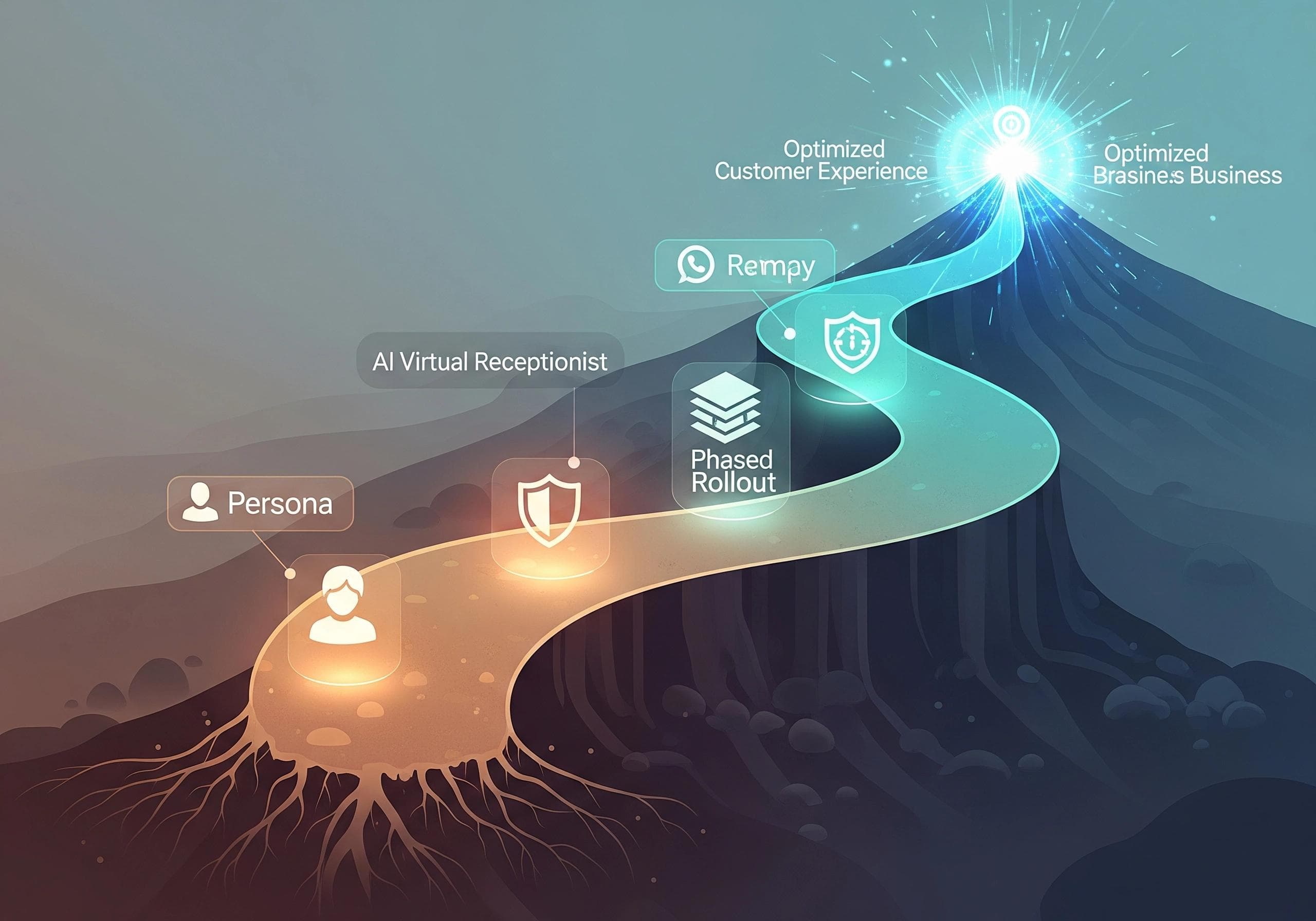
Successfully integrating an AI virtual receptionist into your business demands a clear, strategic roadmap. It's not just about adopting new technology; it’s about transforming how you engage with customers and manage operations. Many businesses, seeing the projected growth of the conversational AI market to 30 billion dollars by 2028 and Gartner's prediction of a significant jump in automated interactions by 2026, are eager to implement, but a structured approach is key to unlocking the full benefits.
Define Scope and Goals Precisely
The first step in any successful AI implementation is to clearly define what your AI virtual receptionist will , and won’t , do. Avoid the temptation to automate everything at once. Instead, identify high-volume, repetitive tasks that consume significant staff time, such as answering FAQs, basic troubleshooting, or appointment scheduling. Starting with these specific functions allows for measurable success and quicker integration into your existing workflows.
Clear objectives are the foundation of effective AI integration.
Develop a Brand-Aligned AI Persona
Your AI virtual receptionist is an extension of your brand. Developing a distinct persona,including tone, vocabulary, and empathy levels,is crucial for consistent and positive customer service automation. Consider your target audience and your brand’s voice. Should your AI be formal and efficient, or friendly and conversational? A well-crafted persona ensures seamless interactions that resonate with your customers.
Prioritize Robust Security Standards
Data security cannot be an afterthought, especially when handling customer information. When choosing a platform, ensure it adheres to stringent security standards like SOC2 Type II compliance. This certification demonstrates a commitment to managing customer data securely, protecting sensitive information, and maintaining trust. Platforms like the AI Placers' voice AI platform prioritize these critical security measures.
Implement a Phased Piloting Strategy
Instead of a full-scale launch, opt for a controlled pilot. Deploy your AI virtual receptionist in a specific department or for a defined set of tasks. This deployment strategy allows your team to gather real-world feedback, identify potential friction points, and make necessary adjustments before a broader rollout. It’s an iterative process that refines the system based on actual user experience.
Start small, learn fast, and scale confidently.
Monitor and Optimize with Key Metrics
Successful AI implementation is an ongoing process of review and refinement. Establish key performance indicators (KPIs) such as call resolution rates, average handling time, customer satisfaction scores (CSAT), and the percentage of calls deflected from human agents. Use these metrics to continuously optimize your AI's performance and ensure it consistently delivers value. Many voice AI platform providers offer real-time reporting and performance analytics to guide your efforts. To truly automate your office and maximize the potential of your new AI virtual receptionist, this data-driven approach is indispensable.
Ready to transform your customer interactions with cutting-edge AI? Discover how AI Placers can provide your business with intelligent, human-sounding AI voice agents for unparalleled customer service.
Frequently Asked Questions about AI Virtual Receptionists
How has the AI virtual receptionist evolved by 2026?
By 2026, AI virtual receptionists have evolved significantly from basic IVR systems. They now leverage Generative AI and Large Language Models (LLMs) to engage in fluid, natural conversations, understanding intent, tone, and context. This allows for a much more human-like and effective customer interaction.
What are the main benefits of using an AI virtual receptionist system?
AI virtual receptionist systems offer substantial benefits, including 24/7 availability with zero wait times, significant operational cost reduction (up to 70%), and enhanced customer satisfaction. They can handle routine tasks, qualify leads, and provide instant support, freeing up human agents for more complex issues.
Can AI virtual receptionists handle complex business integrations?
Yes, advanced AI virtual receptionist systems in 2026 offer seamless integrations with CRM platforms like Salesforce and HubSpot, as well as scheduling tools such as Calendly. For specialized sectors like healthcare, they also provide HIPAA-compliant data handling for sensitive patient information.
How do AI voice agents ensure natural and engaging conversations?
These systems utilize ultra-low latency voice processing (sub-500ms) and emotionally intelligent voices that can detect caller sentiment and adjust tone accordingly. Innovations in AI enable these agents to mimic human conversation patterns, making interactions feel more authentic and less robotic.
What makes an AI virtual receptionist system essential for businesses today?
AI voice agents are essential because they address the modern customer's demand for immediate, personalized service while helping businesses manage costs. They ensure no customer is left waiting, improve efficiency, and provide consistent, high-quality interactions around the clock.
Are AI virtual receptionists secure and compliant?
Leading AI virtual receptionist systems in 2026 adhere to strict security standards, including SOC2 Type II compliance and advanced biometric voice verification to prevent fraud. For regulated industries, HIPAA compliance is also a key feature, ensuring data privacy and security.